













Philippine businesses expressed tempered optimism in the second quarter of 2025, as concerns over potential U.S. export tariffs and post-election slowdown weighed on sentiment.
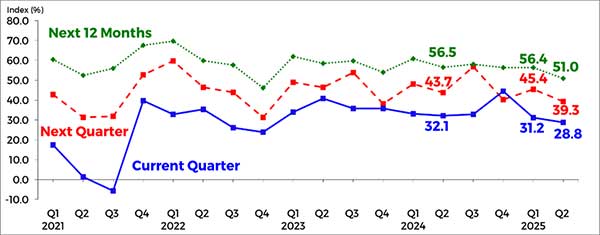
The Bangko Sentral ng Pilipinas (BSP) reported that the Business Expectations Survey (BES) confidence index declined to 28.8 percent from 31.2 percent in the first quarter.
A positive confidence index (CI) indicates that more businesses remain optimistic than pessimistic, though the downward trend reflects growing caution.
Firms cited uncertainties related to reciprocal trade measures on Philippine exports to the United States as a key concern affecting their outlook.
Other seasonal factors, such as the slowdown after the May midterm elections and the sugar industry’s off-milling season, also contributed to the decline in sentiment.
Looking ahead, business confidence for the next quarter stood at 39.3 percent, and at 51.0 percent for the next 12 months, both down from previous levels but still in optimistic territory.
“The continued positive sentiment suggests businesses still see favorable conditions ahead, though less buoyant than earlier this year,” BSP noted.
Firms expect inflation to stay within the National Government’s target range over the next 12 months, reflecting stable and well-anchored price expectations.
This is critical, the BSP said, as it supports investment planning and job generation, particularly in sectors sensitive to interest rates and operating costs.
Stable inflation expectations also allow the BSP to calibrate its monetary policy more effectively, ensuring that real interest rates remain growth-supportive.
The BSP highlighted that the moderation in sentiment reflects businesses’ cautious stance in adjusting to both domestic and global headwinds, rather than a loss of confidence in economic fundamentals.
The BES, conducted from April 4 to May 19, 2025, surveyed 1,527 firms nationwide, including 582 in Metro Manila and 945 in areas outside the capital.
The survey covered all 17 regions of the Philippines using stratified random sampling from the Bureau van Dijk’s database of the country’s top 7,000 corporations.
The nationwide response rate was 61.2 percent, with slightly higher participation from Metro Manila businesses compared to the first quarter.
The BES serves as a key surveillance tool for the BSP and helps guide monetary policy decisions by tracking private sector sentiment across industries.
Despite the moderation, Philippine firms remain largely upbeat about medium-term growth prospects, supported by steady domestic demand and a manageable inflation environment.