












By Glazyl M. Jopson
DUMAGUETE CITY, Negros Oriental — Foundation University continues to empower young innovators by encouraging students to develop creative, technology-driven solutions that address real-world community needs.
Through its academic programs and innovation initiatives, the university gives students opportunities to turn ideas into practical projects that can benefit local communities while strengthening skills beyond the classroom, especially in a fast-evolving digital landscape.
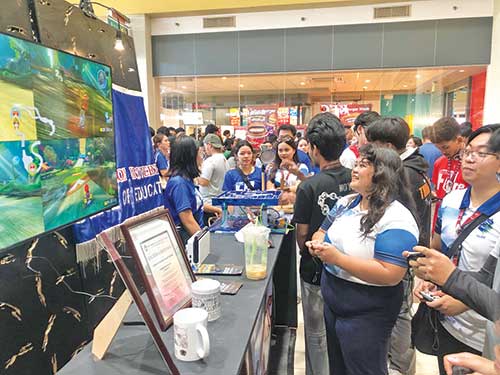
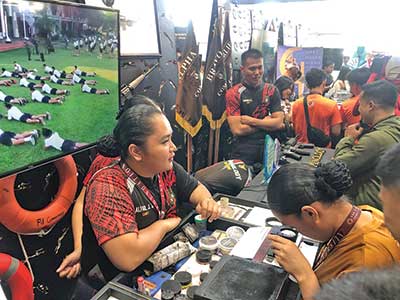
More than 200 students showcased their creativity and technology-driven innovations during the university’s recent annual Digital Expo at Robinsons Dumaguete.
The event also marked the launch of FU77-#Levin7, led by University President Victor Vicente “Dean” Sinco, Innovations Advisor and Marketing Consultant Stephen Sinco, President Emeritus Dr. Mira Sinco, University Chancellor Dr. Charlotte Cariño, and Board of Trustees member Dr. Juan Romeo Nereus Acosta.
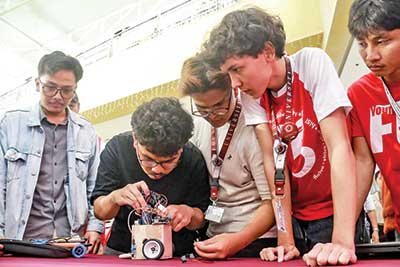
Now in its 18th year, the Digital Expo featured a wide array of student projects, including robotics demonstrations, prototype systems and interactive displays highlighting the university’s focus on technology and creative solutions.
Among the notable presentations was a virtual reality gallery showcasing different mangrove species, developed by the Department of Fine Arts in collaboration with the SIIT Mangrove Ecopark.
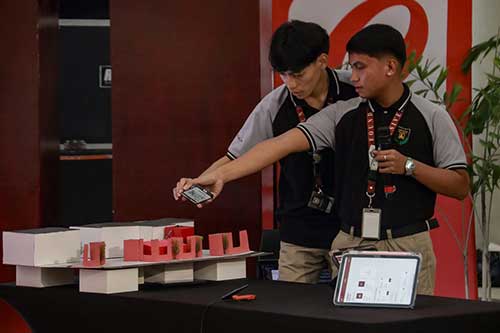
Students from the College of Computer Science also demonstrated intelligent robotic hounds, while the Department of Architecture presented bamboo truss structures designed for sustainable construction.
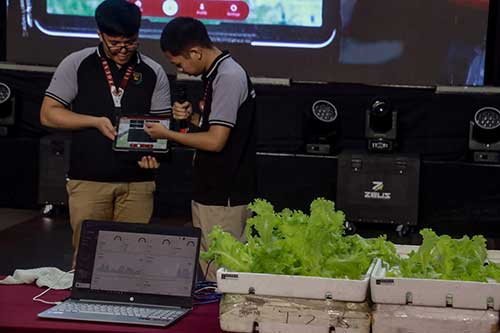
A hydroponics prototype previously presented by the university’s College of Agriculture was refined and has since been fully implemented on campus to grow lettuce.
The university-grown lettuce is now being supplied to local restaurants and grocery stores.
The Foundation Preparatory Academy, meanwhile, has been presenting student-developed robots every year.
The university’s robotics program, integrated into the Senior High School STEM strand and enhancement classes for Grades 4 to 10, has produced a competitive robotics team that excelled in the National Robotics Competition in the Visayas.
“These examples show how the Digital Expo serves not only as a showcase of student creativity, but also as a launchpad for real-world applications,” University President Sinco said.
One student, Samuel James Sy of Estudio Damgo from the Department of Architecture, said their project aims to be sustainable by ensuring community participation from the early stages of development.
“We want the community to be involved in the project so they can eventually own it,” the student said.
“We are not the users — we are just designing for them.”
He said the experience of developing real-world projects has also boosted their confidence as they prepare for professional careers.
“It’s a big leap for us as students,” the student added.
“We haven’t experienced building something like this before in order to graduate. It’s challenging, but it’s also fulfilling because we learn while helping the community.”
Despite challenges such as limited resources and building connections with communities, students said the process allowed them to better understand real-world applications and professional collaboration.
“Building bonds with the community is quite the challenge for us. Because that’s where the part where the community becomes more of a network — on how we could actually be more successful with this project. So, it’s like a fulfillment on our part,” he said.
“It’s quite a good experience. And at the same time, we can actually learn something for the community itself.”
In his message, Acosta emphasized the importance of innovation while reminding students that technology should never replace humanity.
“For as long as we are in the safe spaces of institutions where we can learn, share, and innovate — kung kayang isipin, kayang gawin,” he said.
Acosta also spoke about the rapid rise of artificial intelligence and digital technology, stressing that while these tools are essential in today’s world, human creativity and compassion must remain central.
“Knowledge is important,” he said.
“You learn from kindergarten to elementary to college to PhD and beyond. But knowledge is linear. It is imagination beyond knowledge that is exponential.”
He warned that excessive dependence on technology could diminish human compassion and interaction.
“Learning cannot be just from a screen, or a gadget, or a smartphone,” Acosta said.
“Learning has to be social. It has to be interactive — person to person, human being to human being.”
He noted that throughout its 77 years, Foundation University has remained at the forefront of education in Negros Oriental, championing not only academic excellence but also sustainable development, green leadership and governance.
University President Sinco echoed that view, saying artificial intelligence is a powerful tool but ultimately relies on data created and interpreted by people.
“The one thing about AI that many seem to forget is that all it is, is a database that a computer accesses,” he said.
“If the database is flooded, so is your idea. That’s why human intelligence is needed to determine what is correct and appropriate. We cannot eradicate the human factor.”
He also said robotics developed by students could potentially be applied in fields such as agriculture, particularly in monitoring crops and improving yields.
Partnerships with local government units and the private sector may also be explored in the future.
Students involved in community-based projects also highlighted the importance of collaboration with local communities.
This year’s Digital Expo, according to Sinco, reflects the school’s three pillars — innovation, culture and sustainability — and showcases students’ dedication to preserving cultural heritage while pursuing the development of the next generation of tech professionals.
The university is also among the early institutions in the country to implement an iPad-based education program, first introduced 15 years ago.
It also uses the Foundation University Expanded Learning platform, or FUEL, to streamline communication, assessment, content delivery and collaboration between faculty members and students in an integrated digital environment.
“By embracing educational technology early on, Foundation University has created an innovative learning environment that enhances student engagement, strengthens digital skills, and prepares learners for a technology-driven world,” Sinco said.
As Foundation University continues to celebrate innovation and creativity, the university hopes to inspire future leaders who will use their knowledge, imagination and compassion to make a meaningful impact on society.
Foundation University was founded in 1949 by Dr. Vicente G. Sinco to help rebuild Philippine education in the aftermath of World War II and expand access to deserving Filipino youth.
Established as a nonprofit and secular institution, it aims to develop principled and competent leaders grounded in Filipino identity and national purpose.