





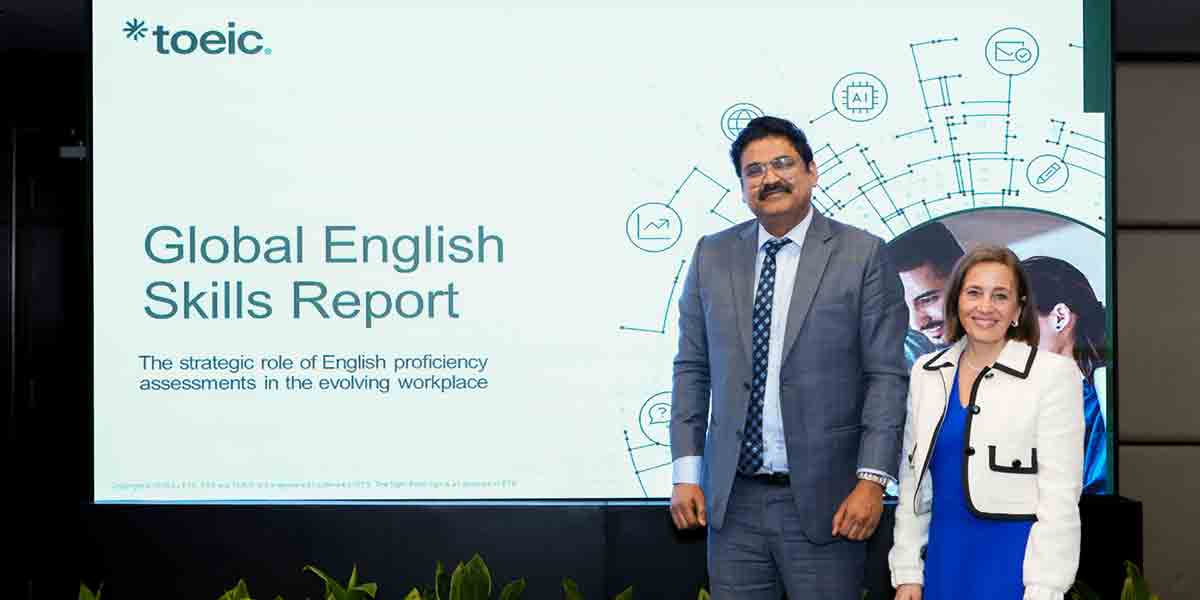









Eight in 10 employers worldwide say integrating artificial intelligence tools is increasing the need for English proficiency in the workplace, according to a new global study released March 9, 2026, by ETS’s TOEIC, the global leader in assessing English communication skills for the workplace.
The TOEIC Global English Skills Report surveyed more than 1,300 human resources decision-makers across 17 countries, finding that English proficiency has become a foundational workforce capability as organizations accelerate AI adoption and expand global operations.
The report directly challenges the assumption that AI can compensate for language gaps.
Across reading, writing, listening, and speaking, about six in 10 global employers say AI cannot make up for a lack of English proficiency.
Nine in 10 employers say English skills are needed for using AI interfaces, generating effective prompts, and evaluating AI-generated information.
Ratnesh Jha, Global General Manager of Institutional Products at ETS, said the findings reframe how organizations should think about language skills in the AI era.
“AI doesn’t close the skills gap. People do,” Jha said. “What this research makes clear is that English is now a core workforce capability, not a soft skill. It’s how employees collaborate across borders, how organizations unlock the value of AI, and how talent stays relevant in a rapidly changing economy. Companies that invest in English proficiency are investing directly in productivity, innovation, and global competitiveness.”
Among the report’s key findings, 90 percent of employers say English proficiency is critical to organizational success, while 92 percent say it is more important today than it was five years ago.
Eighty-one percent of employers report that integrating AI tools increases the need for workplace English proficiency, underscoring that technology is amplifying — not replacing — the demand for strong communication skills.
The report also highlights the growing role of English assessment in hiring and workforce development.
Employers report most commonly using assessments for recruitment at 78 percent, pre-training evaluation at 71 percent, and promotion readiness at 66 percent, with standardized third-party assessments rated as the most effective approach.
Organizations using standardized English assessments report stronger outcomes across key performance areas, including organizational growth, competitive standing, employee productivity, workflow efficiency, and professional development.
Eighty-six percent of employers say organizations without fluent English speakers are at a competitive disadvantage.
Eighty-three percent report that hiring candidates with insufficient English skills imposes real costs, including lower productivity and retention.
Looking ahead, 84 percent of employers predict that within five years, organizations in their country will invest in English assessments and education.
As AI becomes embedded in everyday work and global collaboration accelerates, the TOEIC Global English Skills Report positions English proficiency as a strategic enabler of workforce readiness, economic mobility, and technological adoption.
The report’s findings suggest that organizations able to accurately measure and develop English skills will be better equipped to drive growth, engage employees, and compete in an increasingly AI-powered global economy.
To read the entire TOEIC Global English Skills Report, download it here (https://www.ets.org/toeic/resources/global-english-skills.html?utm_source=newrooms&utm_medium=cnt&utm_campaign=toeic-global-english-skills-report-global-awa-2026-q2-03&utm_content=launch-pr)