













Alibaba Group said its cloud and artificial intelligence systems helped make the Olympic and Paralympic Winter Games Milano Cortina 2026 “the most intelligent Games in Olympic history,” as the International Olympic Committee and organizers leaned on digital tools to manage energy use, transport, broadcasting, and fan engagement.
The Olympic Winter Games in Milano Cortina ran from Feb. 6 to 22, 2026, while the Paralympic Winter Games are scheduled for March 6 to 15, 2026, according to the official Games schedule.
Alibaba Cloud, the digital technology arm of Alibaba Group and a Worldwide TOP Partner of the IOC, said its technology stack was used to help the IOC and the Milano Cortina organizing committee monitor and manage energy consumption, optimize transportation systems, enhance broadcasting operations, and support the IOC’s first use of large language model technology.
Kirsty Coventry, International Olympic Committee President, said: “Every Olympic Games leaves its own mark in terms of technological innovation. With Alibaba’s Cloud technologies and Qwen models, these Games have set a new benchmark for intelligence and creativity.”
Dr. Feifei Li, Senior Vice President of Alibaba Cloud Intelligence Group, President of International Business, said: “Milano Cortina 2026 marks a milestone with the first use of LLM technologies in the Olympic history powered by Alibaba’s Qwen models. Our cloud and AI-powered systems that supported Milano Cortina 2026 demonstrate our dedication to enabling smarter operations, deeper engagement, and new possibilities for the Olympic Movement.”
Alibaba Cloud said its AI-driven sustainability tools and energy-efficient cloud infrastructure enabled Milano Cortina 2026 to measure and analyze carbon emissions, creating what it described as a scalable model for future host cities seeking more energy-efficient and carbon-saving Olympic Games.
Among the systems deployed was an Enhanced Energy Data Management System across all competition venues, allowing organizers and the IOC to monitor and analyze energy consumption and carbon emissions in real time.
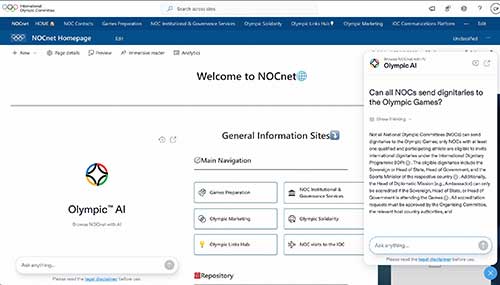
The IOC is also testing an intelligent chatbot powered by Alibaba’s Qwen large language models, which the company said enables staff to access both historical and real-time insights on electricity usage and power-demand contingency.
Alibaba Cloud also rolled out an Energy Issue Tracking System that digitizes workflows for identifying, escalating, and resolving energy anomalies.
The company said it also co-developed a sustainability platform that allows organizers to assess the full lifecycle footprint of Milano Cortina 2026, with a dedicated focus on long-term benefits for local communities.
The Winter Games unfolded across more than 22,000 square kilometers of northern Italy’s alpine mountains and historic cities, which Alibaba Cloud described as the widest geographical spread in Olympic history.
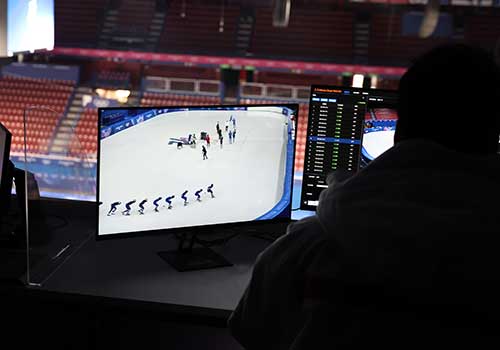
To support officiating, the IOC and Alibaba Cloud introduced a Video Adjudication system built on low-latency livestreaming technology and integrated into core competition infrastructure.
Alibaba Cloud said the system synchronizes multiple video signals to help referees identify fouls and review scoring disputes through instant arbitration playback.
The company said the technology was deployed in Freestyle Skiing and Snowboard Slopestyle events to improve judging accuracy.
Alibaba Cloud’s Transportation Management System also linked venues across long distances and provided mobility support for IOC staff, athletes, volunteers, media workers, and other key personnel.
Through the Milano Cortina 2026 Transport App and related services, athletes and Olympic staff were able to access personalized trip planning and real-time updates through official transport services, with the app mobilizing more than 80,000 individuals during the Games.
Other applications, including an e-voucher system supplying meals to tens of thousands of Olympic stakeholders and a meteorological service portal providing real-time weather information for outdoor competitions, also ran on Alibaba Cloud infrastructure, the company said.
For media operations, Alibaba Cloud said its Apsara Video technology powered cloud-based live streaming and broadcasting for press conferences, IOC daily briefings, and post-competition athlete interviews in real time.
The company said its fully cloud-hosted Game Video Content Distribution service supported journalists with video processing, editing, live and on-demand distribution, and secure downloads.
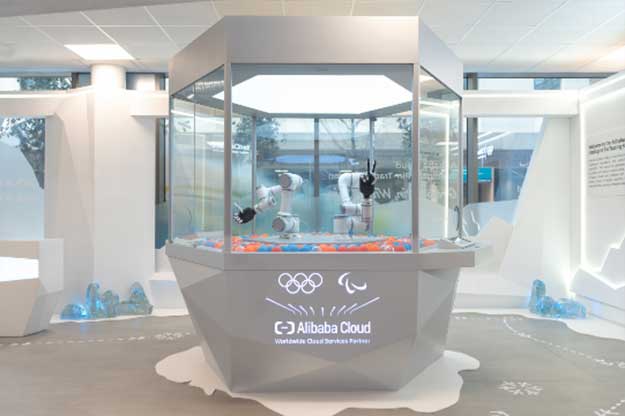
Alibaba Cloud also introduced an “Intelligent Pin Trading Station” in the Milano Olympic Village, adding an AI-enabled twist to the athlete tradition of pin swapping.
Powered by the Qwen model, the station combines embodied devices with an AI system that can understand language and visuals, allowing athletes to place a pin into a capsule, interact by voice and gestures, and receive a pin selected by a robotic arm from a previous participant’s contribution.
Alibaba Cloud said the station facilitated more than 8,000 pin exchanges among athletes during the Games.
The company said Qwen large language models powered the first use of LLM technologies in Olympic history and supported a wider set of tools designed to improve fan engagement, information management, and operations across the Olympic ecosystem.
Those platforms included the Olympic AI Assistant, NOC AI Assistant, and the Sports AI Platform, which Alibaba Cloud said enabled multilingual fan interactions, intelligent content search, and large-scale media management.
In broadcasting, the OBS Live Cloud Platform powered by Alibaba Cloud replaced more traditional satellite-based workflows with cloud-based delivery of 442 live video feeds for 42 broadcasters worldwide.
Alibaba Cloud said the shift also reduced the physical footprint of the Games’ broadcast operations, with Milano Cortina 2026’s International Broadcasting Centre measuring 25% smaller than Beijing 2022 and 30% smaller than Pyeongchang 2018.
The company said advanced AI tools, including Real-Time 360º Replay systems and the Qwen-powered Automatic Media Description System, helped modernize live production workflows and speed up media turnaround.
Throughout Milano Cortina 2026, the Automatic Media Description System processed livestream signals from 391 competition sessions, while Media Rights Holders had access to 4,198 video highlights captured and produced by Alibaba Cloud’s Real-Time 360º Replay systems.
The deployment underscores how Olympic organizers are increasingly using cloud computing, AI, and automation not only to improve fan-facing experiences, but also to run more complex, geographically dispersed, and data-heavy sporting events.
For Alibaba Cloud, the Milano Cortina project extends a long-running collaboration with the IOC and serves as a showcase for how cloud-based systems can make major international events more sustainable, efficient, and technology-driven.