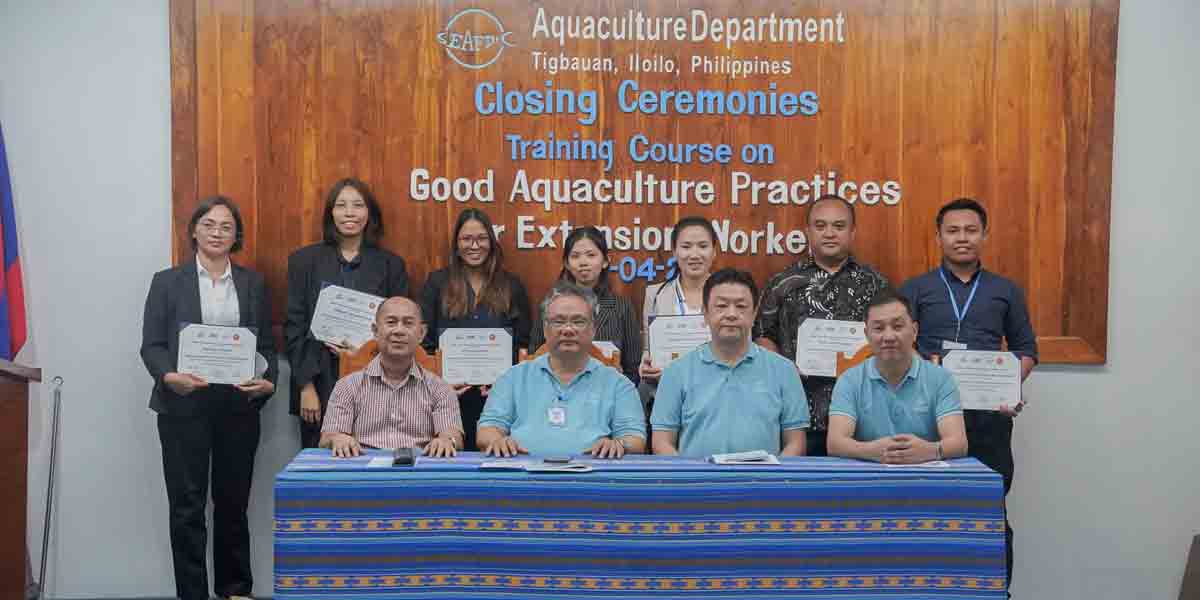









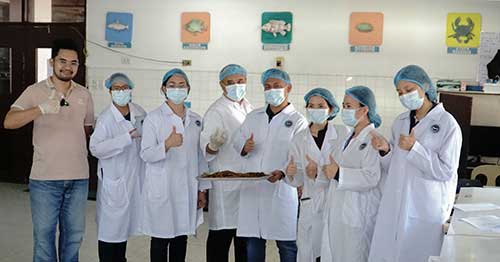
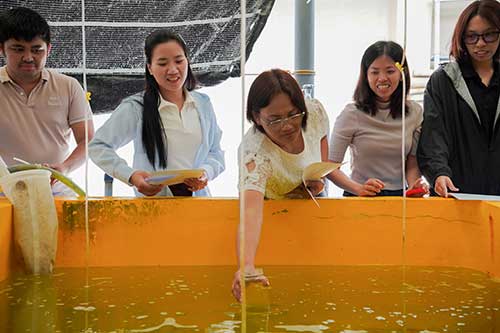
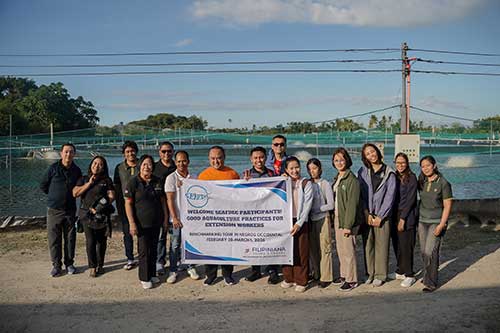
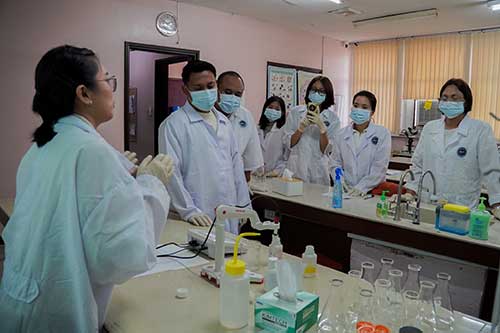
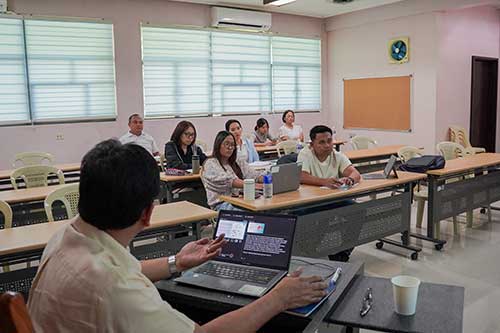
Seven participants from SEAFDEC member states completed the 10-day Training Course on Good Aquaculture Practices (GAqP) for extension workers held from 23 February to 4 March 2026 at the SEAFDEC/AQD Tigbauan Main Station.
Participants represented seven ASEAN countries: Cambodia, Indonesia, Lao PDR, Malaysia, the Philippines, Singapore, and Thailand, with one extension worker from each country.
The training, organized by SEAFDEC/AQD, focused on strengthening food safety, quality assurance, and sustainability in the aquaculture sector.
SEAFDEC/AQD Chief Dan Baliao highlighted the critical role of extension workers in ensuring that scientific innovations reach aquaculture producers.
“You are the vital bridge between the laboratory and the farm, translating complex standards into practical success for our local fish farmers,” Baliao said.
The GAqP training course was organized under the Association of Southeast Asian Nations – Japan International Cooperation Agency (ASEAN-JICA) Food Value Chain Development Project. This technical cooperation initiative between JICA and ASEAN leverages SEAFDEC’s expertise to support regional food security.
Advancing regional capacity for good aquaculture practices
During the opening program, Mr. Yohei Hashimoto, Director of the Agricultural and Rural Development Division 1 of the Economic Development Department at JICA, emphasized the importance of the fisheries sector in the ASEAN region.
“The fisheries sector is vital to food and nutritional security, the economy, and the livelihoods of people in the ASEAN region,” Hashimoto said.
He noted that the training aims to strengthen participants’ understanding of GAqP and encourage the effective application of these practices in their respective countries.
Dr. Takahiro Sajiki, Deputy Chief of SEAFDEC/AQD, added that while aquaculture production in Southeast Asia continues to grow, the sector still faces challenges related to production stability, product safety, and environmental sustainability.
He expressed hope that participants will apply the knowledge and practical skills gained from the training to promote responsible aquaculture development in their countries.
From theory to practice: technical sessions and field activities
Participants attended lectures, workshops, laboratory demonstrations, and field visits, focusing on key aspects of biosecurity, food safety, compliance with standards, and sustainable aquaculture management.
They also presented country reports and exchanged insights on aquaculture practices in their respective countries.
“These exchanges are the true strength of regional cooperation,” said Dr. Leobert de la Peña, Head of the SEAFDEC/AQD Research Division and Technical Lead for the training. “While our contexts may differ, our goals remain the same—responsible, science-based, and sustainable aquaculture development.”
Commitment to sustainable aquaculture beyond the training
During the closing program, speakers emphasized that the knowledge gained from the training should be applied and shared in participants’ respective countries.
Ms. Michiko Umezaki, Chief Adviser of the ASEAN-JICA Food Value Chain Development Center, commended SEAFDEC/AQD for successfully organizing the training and encouraged participants to bring the lessons back to their communities.
“The knowledge and skills gained here are not meant to remain in this room. They are meant to be shared, adopted, and applied in the communities,” Umezaki said.
Participants also expressed appreciation for the opportunity to learn and collaborate with colleagues from across Southeast Asia.
Dr. Michelle Patoc of the Department of Agriculture-Bureau of Fisheries and Aquatic Resources of the Philippines described the training as “enriching and transformative,” noting that it strengthened participants’ knowledge and inspired them to become stronger advocates of responsible aquaculture.
Mr. Endri Hendriansyah of Indonesia’s Ministry of Marine Affairs and Fisheries, shared that he intends to relay the knowledge gained from the training to officials in the Ministry of Marine Affairs and Fisheries.
Moreover, Mr. Mohamad Amir Mustaqim Bin Che Kadir of Malaysia’s Department of Fisheries said he plans to present the information to his supervisors and explore possible improvements to aquaculture procedures in his country.
Closing the program, Dr. Edgar Amar, Head of the SEAFDEC/AQD Training and Information Division, emphasized that promoting good aquaculture practices is essential to the future of the industry.
“This training on good aquaculture practices is more than just a learning activity,” Amar said. “It is a commitment to produce safe and quality food products while protecting natural resources and improving livelihoods across the aquaculture value chain.”