














The headline inflation rate in Guimaras stood at 0.4 percent in February 2026, returning to positive territory after the province posted -0.6 percent in January, according to the Philippine Statistics Authority (PSA).
Headline inflation is the overall rate at which prices are rising in an economy.
It measures changes in the consumer price index (CPI) across a broad basket of goods and services, including food and energy.
In plain terms, it is the “top-line” inflation number most people see in news reports.
It differs from core inflation, which usually excludes food and energy, because those prices can swing sharply from month to month.
“This resulted in a year-to-date inflation rate of -0.1 percent for the province,” Provincial Statistics Officer Nelida B. Losare said.
“Despite the slight improvement, inflation in Guimaras remained significantly lower compared with the national inflation rate of 2.4 percent and the Western Visayas regional rate of 3.0 percent during the same period,” Losare added.
Plainly, overall consumer prices in Guimaras were 0.4 percent higher than they were in February 2025.
National inflation accelerated to 2.4 percent in February, while Western Visayas recorded 3.0 percent, highlighting Guimaras’ relatively slower pace of price increases.
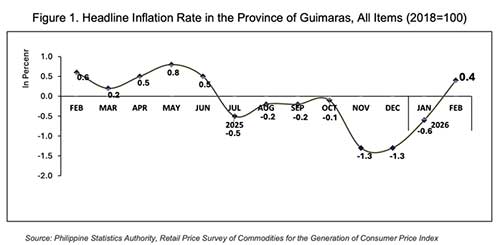
Losare said the upward movement in inflation in February was primarily driven by faster annual price increases in selected commodity groups, particularly food and non-alcoholic beverages, housing, water, electricity, gas and other fuels, and restaurants and accommodation services.
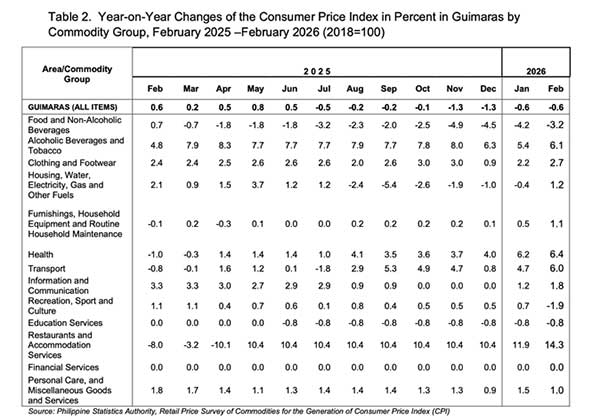
Food and non-alcoholic beverages posted a slower annual decline of -3.2 percent in February from -4.2 percent in January.
“Within the food and non-alcoholic beverages commodity group, cereals and cereal products, particularly rice, accounted for the largest contribution to the group’s inflation movement,” Losare said.
“Cereals registered an inflation rate of -19.6 percent and contributed a 37.1 percent share to the inflation of the food and non-alcoholic beverages group,” Losare added.
Housing, water, electricity, gas and other fuels registered a higher inflation rate of 1.2 percent in February, up from -0.4 percent in January.
“The increase was largely driven by electricity, gas and other fuels, which posted 1.9 percent inflation and accounted for 71.8 percent share of the inflation of the group,” Losare said.
“This movement was mainly attributed to price changes in electricity from various sources such as coal, solar, and hydroelectric power,” she added.
In restaurants and accommodation services, restaurants, cafes and similar establishments with full service recorded the largest share of inflation within the group.
“This category posted 14.3 percent inflation and accounted for a 100 percent share of the inflation of restaurants and accommodation services,” Losare said.
Other commodity groups that posted faster annual increases in February than in January were transport, at 6.0 percent from 4.7 percent; alcoholic beverages and tobacco, at 6.1 percent from 5.4 percent; furnishings, household equipment and routine household maintenance, at 1.1 percent from 0.5 percent; clothing and footwear, at 2.7 percent from 2.2 percent; information and communication, at 1.8 percent from 1.2 percent; and health, at 6.4 percent from 6.2 percent.
By contrast, recreation, sport and culture recorded a slower inflation rate of -1.9 percent in February from 0.7 percent in January.
Personal care, and miscellaneous goods and services, also posted slower inflation at 1.0 percent from 1.5 percent.
Education services retained their previous month’s inflation rate of -0.8 percent.
Financial services also retained its previous month’s inflation rate of 0.0 percent.
In terms of contribution to the province’s overall inflation, restaurants and accommodation services posted the largest share, accounting for a 191.2 percent contribution, or 0.76 percentage point, to Guimaras’ overall inflation rate.
“Within this commodity group, restaurants, cafés and similar establishments with full service registered the highest contribution at 100 percent or 14.30 percentage points, highlighting the significant impact of dining services on the inflation outcome during the month”, Losare said.
“Transport also contributed significantly to the province’s inflation. Within this group, passenger transport services posted the largest contribution at 132.7 percent or 7.96 percentage points, largely influenced by price movements in passenger transport by sea and inland waterways,” Losare added.
Losare said tobacco products posted the highest contribution within the alcoholic beverages and tobacco group, accounting for 51.12 percent or 3.12 percentage points, largely because of price changes in cigarettes.
She said inflation is derived from the consumer price index, which measures changes in the average prices of goods and services commonly purchased by households over time.
In February, the consumer price index in Guimaras was 133.8.
“The CPI serves as the primary indicator used in computing the inflation rate, as it tracks movements in the prices of a fixed basket of goods and services typically consumed by households,” Losare explained.
She said this means a typical Guimarasnon household would need PHP 1,338 in February 2026 to buy the same basket of goods and services that cost PHP 1,000 in 2018, the base year used in computing the CPI.
Meanwhile, the purchasing power of the peso in Guimaras remained at PHP 0.75 in February, indicating that PHP 1.00 in 2018 was equivalent to only PHP 0.75 worth of goods and services during the month.
“This level was unchanged from January 2026 but slightly lower than the ₱0.76 recorded in December 2025, reflecting a modest decline in the purchasing power of the peso at the beginning of the year,” Losare said.
“Overall, the February 2026 inflation results indicate that price levels in Guimaras have started to recover from the negative inflation recorded in previous months, although price increases remain relatively moderate compared with the regional and national trends,” Losare added.