















By John Anthony S. Estolloso
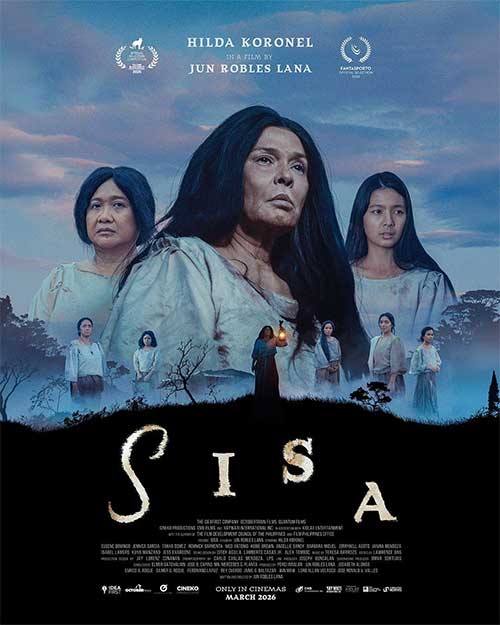
Hilda Koronel is ‘Sisa’.
With a sly nod to the character from Rizal’s novel, her character loses herself to the follies of the narrative’s zeitgeist: imperialism, genocide and reconcentration, discrimination, and the degradation of women.
Jun Lana’s 2025 cinematic historical fiction reimagines a part of our history which seem to be replayed in parts of the world today. Riding the wave of resurgent imperialisms, ‘Sisa’ nitpicks the price with which these are paid for. Set during the pacification stage of the American occupation of the country in the 1900s, the film narrates an overlooked side of that militarized story, one inflicted on ordinary civilians.
At the film’s onset, Koronel walks distractedly into an American concentration camp of distracted people, mostly women who have lost everything: husbands, brothers, sons, their sense of identity and community, and eventually, personal dignity. She mingles in and immerses into the sordid conditions of the camp. To the rest, she is just another woman deranged by the brutalities of war. Listless and lost, she rambles around, sans name and identity, until the moniker of Rizal’s madwoman was attached to her by the incarcerated reconcentradas. She becomes Sisa, maddened by the madness of her times.
We never know her real name. As the eponymous character, Koronel lends an unflinching gravitas to the narrative. She is mad, in all senses of the word – yet not insane as to lose sense of the world. In her interactions with the people she encounters, she comes to terms with realities that burn through principles and demolishes them, one epiphany and truth at a time.
The film develops into a simulacrum of the machinations of imperialism: where the oppressed are pitted against each other as a means of establishing the colonizer’s dominance, and where futile resistance is sublimated as madness. In a frenzied climax to the plot, the women fall on each other to protect personal interests, the physicality of their violence resonant of the futility of escape from their oppressions – and Sisa becomes the main witness to this drama.
Eugene Domingo as long-suffering mother Delia somehow provides a foil to the madness; she suffers patiently through deaths and drudgeries – only to succumb to this madness at the end. Jennica Garcia as the alluring Leonor is both sultry and demure in her tryst with the enemy: infatuated with the camp commandant, she finds no shame nor sorrow in professing that America is Big Brother come to help. But she is no Judith hellbent in redeeming her people; she becomes an accomplice to the act of colonialism which still manifests itself today in the Filipinos’ obsession of whiteness and things stateside and Americana.
Perhaps it is trite to call the film as another cinematic commentary of the times – but there lies the paradoxical rub. As before as now, there is the interrogation of ever-present social themes: of gender roles – that women scrub the floors, cook the meals, do the laundry, and accomplish every menial chore while men do the yapping on the table; of the foul performative of hegemony where imperialist states play kingmakers in ‘toppling dictatorships’ and replacing them with puppet governments; that the colonizer can physically take advantage of the colonized and get away it.
There are no heroines in the story; there is no redemption either, no deus ex machina to save the characters and enshrine the narrative as some noble Greek tragedy; there was only madness piled upon madness. At the end of it all, it is women who are left to clean up the mess. As symbolic finale, there must be a purgation of iniquities, even at the cost of a holocaust. In the last few minutes of the film, all male characters are retching with poison-laced food and the refectory is drenched with gasoline. In ending, Sisa holds aloft a lit quinque, in sardonic imitation of Lady Liberty with her torch. There is no self-immolation of flames closing the scene – but of what need is fire when all of them are already too scorched with colonial mentality?
In a time when American imperialist tendencies are resurgent, when American bombs are raining somewhere among civilians, in the name of liberty and democracy, one is left to wonder how many Sisas are wandering listlessly around amid the butchery and violence, looking for lost fathers, brothers, and sons.
This country went through that hell before. Then as now, the situation is insane.
(The writer is a language and literature teacher in one of the private schools of the city. The film poster is from Reddit.)