











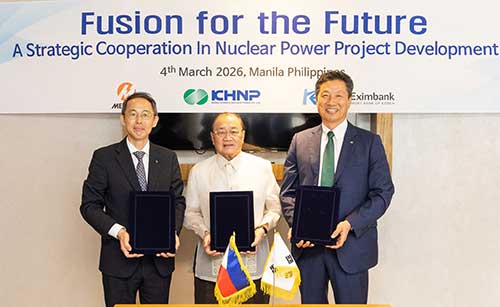
Manila Electric Co. (Meralco) has expanded its nuclear energy push after signing a memorandum of understanding with Korea Hydro & Nuclear Power (KHNP) and the Export-Import Bank of Korea (KEXIM) to study technical and financing pathways for future nuclear power projects in the Philippines.
The partnership centers on Meralco’s Nuclear Energy Strategic Transition (NEST) program, which aims to incorporate nuclear power into the country’s energy mix.
The agreement was signed during the Philippines-Korea Business Forum on March 4 in Pasay City.
Present at the signing were Meralco Chairman and Chief Executive Officer Manuel V. Pangilinan, KHNP Chief Executive Officer Dae Wook Chun, and KEXIM Chairman and Chief Executive Officer Kiyeon Hwang.
Meralco, the country’s biggest power distributor, said the deal strengthens its effort to assess how nuclear energy could support its long-term generation and energy security strategy.
Under the agreement, the parties will coordinate on reactor design and engineering discussions, technical information exchange, and knowledge-sharing activities.
The cooperation will also cover efforts to improve the Philippines’ legal and institutional frameworks for nuclear power.
The three groups agreed to help build a dedicated local workforce through training programs, employee exchanges, and knowledge-sharing activities to support long-term operational capability.
The collaboration may also extend to early-stage project development activities, including public acceptance initiatives, project planning, feasibility assessments, site analysis, and site-selection studies.
In addition, the parties will work on business and financial modeling to support potential nuclear projects in the Philippines.
As part of the effort, KEXIM will explore possible financing structures and credit facilities that could support Meralco’s prospective nuclear developments with South Korean firms.
KHNP is a subsidiary of Korea Electric Power Corp. and is the leading power generation company in South Korea.
KEXIM is a state-owned export credit agency and financing arm of the South Korean government.
Pangilinan said nuclear power could help strengthen the country’s power system while broadening Meralco’s generation portfolio.
“Nuclear energy is a way to diversify our portfolio and reinforce energy security, while offering a degree of insulation from fuel market fluctuations,” he said.
He said the initiative aligns with the Philippine government’s broader efforts to prepare for a civilian nuclear energy program.
“Complementary to the Philippine government’s efforts to lay the groundwork for its nuclear power program, Meralco is assessing how nuclear [energy] can best contribute to our long-term strategy,” he added.
Pangilinan said the partnership allows Meralco to study possible technologies and project models with support from experienced international institutions.
“Partnering with KHNP and KEXIM gives us access to proven global expertise and enables us to study technology, business models, and financing options with greater depth,” he said.
He described the memorandum as an early but important step in evaluating the role nuclear energy could play in the country’s future electricity system.
“This MOU marks an early but consequential step in this important process,” Pangilinan concluded.
The agreement comes as the Philippines continues laying the groundwork for nuclear power as part of its long-term energy planning and energy security agenda.
Meralco is seen as a major participant in the government’s anticipated nuclear market.
In February, the company received a USD 2.7 million grant from the U.S. Trade and Development Agency to finance a feasibility study on tapping small modular reactors.
Meralco said small modular reactors have a capacity ranging from 300 to 450 megawatts.
The latest deal with KHNP and KEXIM adds a South Korean technical and financing dimension to that effort, giving Meralco another route to examine how nuclear energy could eventually be deployed in the Philippines.